
Table of Contents
Description
FART was my semester project for the Computer Science 658 class at Grand Valley State University. My goal is for FART to be a distributed, object-oriented raytracer. The name is a recursive acronym taking inspiration from LAME. It stands for Fart Ain't a RayTracer.
FART takes as input a scene-description file in an ASCII-based, hierarchical input file format. After the scene file is parsed, it will be raytraced (rendered) according to the render options. Some of these options can be specified on the command line and others can be specified in the scene description file. When a given option can be specified both places, the command-line options will override what is in the scene file.
Rendering can be done using the built-in distributed algorithm. Command-line options will be utilized to specify a “host file” which can contain a list of hosts to use while rendering the scene. The algorithm is fault-tolerant so that if one of the worker nodes goes down the work can be reorganized to complete that section of the image.
Code
Obtaining
You can retrieve a copy of FART from my Git repository using the command
$ git clone git://holtrop.mooo.com/fart.git
Dependencies
You'll need these packages to build:
rubylibfl-devlibfreeimage-dev
Building
$ ./configure
$ make
Executing
Example:
$ ./fart scenes/infinity.fart
Usage:
Usage: ./fart [options] <scene-file>
  Options:
    -o|--output-file <output-file-name>
    -w|--width <image-width>
    -h|--height <image-height>
    -m|--multisample <level>
    -f|--field-of-view <vertical-fov>
    -d|--max-depth <max-recursion-depth>
    -a|--ambient-occlusion <ambient-occlusion-level>
    -p|--preview  (means -w400 -h300 -m1 -d8 -a0)
       --hosts <hosts-file>
Documentation
See the syntax page.
To Do
- High priority
- multi-core rendering in non-distributed mode (pthread)
- Medium priority
- add fog
- add spotlight and directional light types
- allow includes/modules in scene files
- allow textures in materials
- Low priority
- kd_tree optimization
- fix materials of boolean objects where transparency / refraction levels differ
Screenshots / Revision History
Revision 25
I can write .bmp files but I'm not doing anything with scene data yet.

Revision 43
FART can intersect a ray with a sphere but doesn't have lighting/shading/material colors yet…

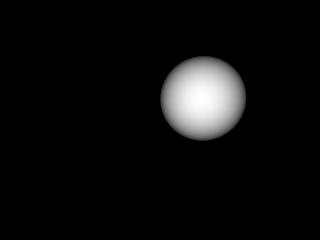
Revision 45
Cheap lighting based on implicit light source at the viewpoint
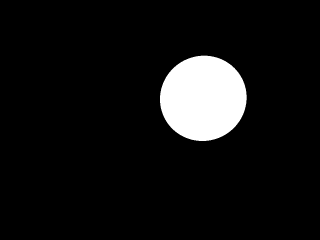
Revision 46
Multisampling is working (back to a flatly-shaded sphere to show the anti-aliasing effect on the edges)
Revision 62
Added a Plane shape type, I really need to get some better lighting working

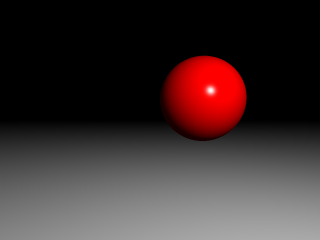
Revision 76
Phong shading model working with ambient, diffuse, and specular light components
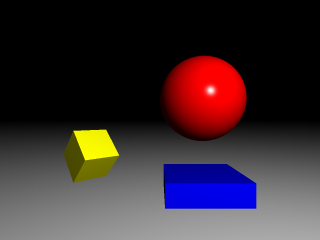
Revision 121
Added a Box object. No, it didn't take 45 revisions just for that. I've been working on the parser for the scene input files a lot as well.
Revision 134
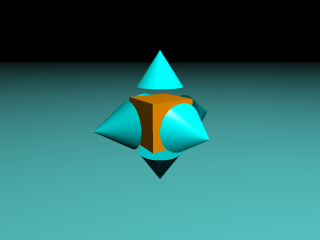
Added a Cyl object. Cyl objects can be cones or cylinders - they have a bottom radius, a top radius, and a height.
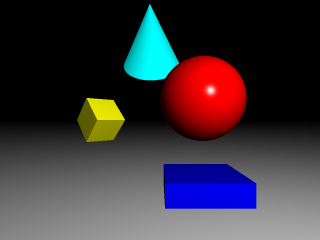
Revision 155
Boolean intersections working. I had to rework the way I was returning intersections to also return a reference to the actual shape that was intersected with so that Intersect shapes would really return the child shape that produced the point.
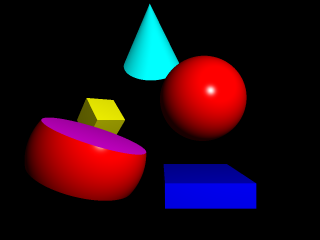
Revision 162
A few bug fixes, and added Union and Subtract shape types.
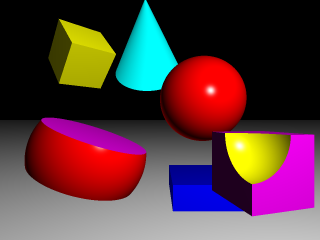
Revision 176
More bug fixes, and reading the scene description from a file is finally working!
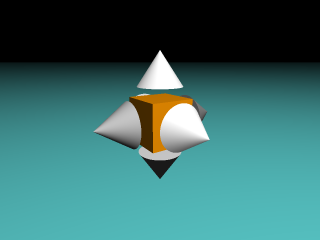
Revision 180
Material definitions working
Revision 187
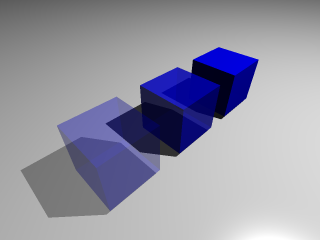
Recursion working for transparent objects. Rays sent from surface point to each light source now intersect with other objects to produce shadows depending on the transparency of the objects between the surface point and the light source.
Revision 196
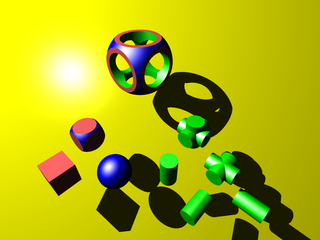
Added scenes/csg.fart as an example of doing CSG. Also fixed a bug in the loading of boolean objects.
Revision 202
Changed intersection method to also return surface normals (instead of accessing them through a separate function, getNormalAt()). This allowed Subtract objects to invert the normals obtained by the sub-object being subtracted out. This, in turn, allowed subtractions of subtractions to re-invert them, and so on and so forth…
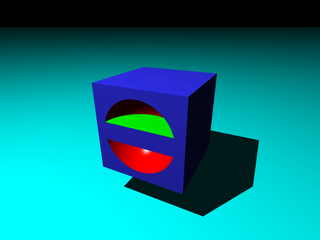
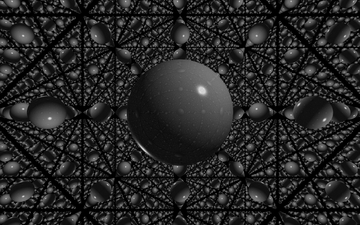
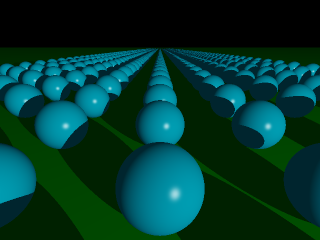
Infinity scene
Created from scenes/infinity.fart
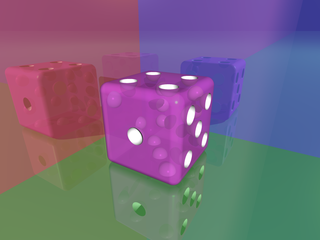
Die scene
Created from scenes/die.fart
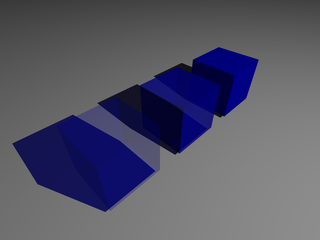
Revision 211
Light passing through transparent objects is colored by the objects
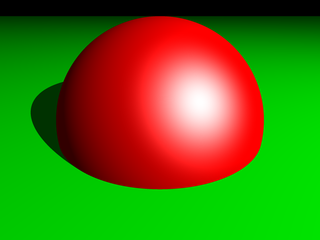
Revision 251
Exposure function replaced saturation model - thanks Nick!
 | 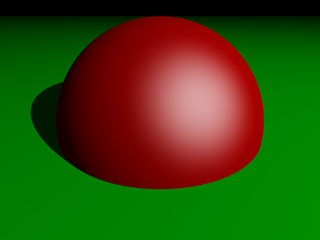 |
| Before Exposure | After Exposure |
|---|
Revision 258
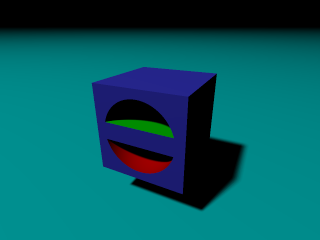
Soft shadows possible with “radius” and “jitter” keywords on light objects
Revision 262
Nick inspired me to add ambient occlusion
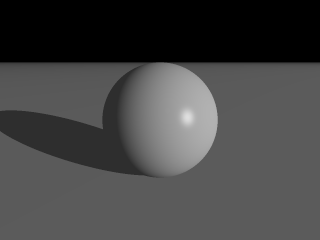 | 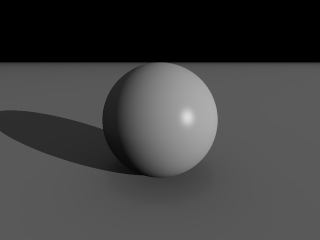 |
| Before ambient occlusion | After ambient occlusion |
|---|
Revision 281
Added Extrude objects
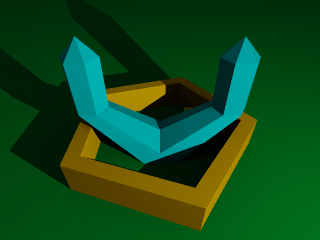
Revision 289
Added shape definitions for easy shape reuse
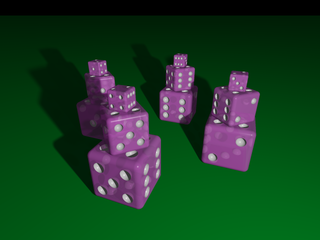
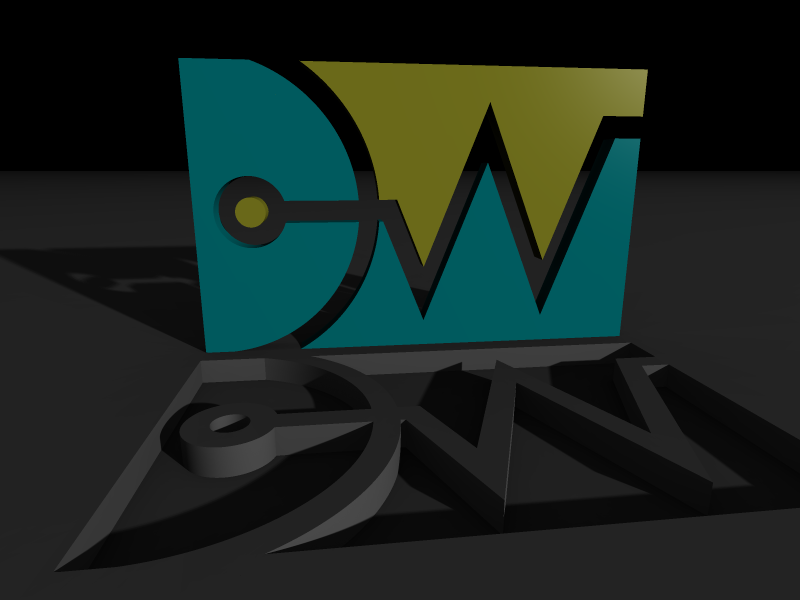
Revision 316
Created from scenes/dw.fart
*** Beginning scene render ***
Parameters:
----------------------------------------
    Width: 800
    Height: 600
    Multisample Level: 3
    Ambient Occlusion Level: 5
    Vertical Field of View: 60
    Max Depth: 10
----------------------------------------
 *** Ending scene render ***
|  |
Elapsed time: 28583.5 seconds (7 hours, 56 minutes, 23.4698 seconds) |
|
Revision 351
Added scene file scripting with variables, expressions, and control structures. Sample output showing result of a doubly-nested for() loop.
Created from scenes/for-test.fart
*** Beginning scene render ***
Parameters:
----------------------------------------
    Width: 320
    Height: 240
    Multisample Level: 2
    Ambient Occlusion Level: 0
    Vertical Field of View: 60
    Max Depth: 10
----------------------------------------
 *** Ending scene render ***
|  |
Render time: 156.877 seconds (2 minutes, 36.8771 seconds) |
|
Revision 360
Added if statements which can take optional elsif clauses and an optional terminating else
Created from scenes/if-test.fart
 *** Beginning scene render ***
Parameters:
----------------------------------------
    Width: 320
    Height: 240
    Multisample Level: 2
    Ambient Occlusion Level: 0
    Vertical Field of View: 60
    Max Depth: 10
----------------------------------------
 *** Ending scene render ***
| 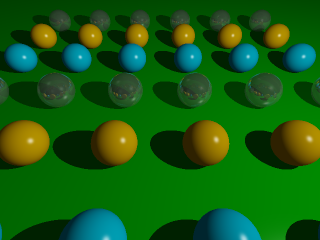 |
Render time: 17.8504 seconds |
|
Revision 367
More fun with for() loops… created from scenes/dw-circle.fart
 *** Beginning scene render ***
Parameters:
----------------------------------------
    Width: 800
    Height: 600
    Multisample Level: 3
    Ambient Occlusion Level: 0
    Vertical Field of View: 60
    Max Depth: 10
----------------------------------------
 *** Ending scene render ***
| 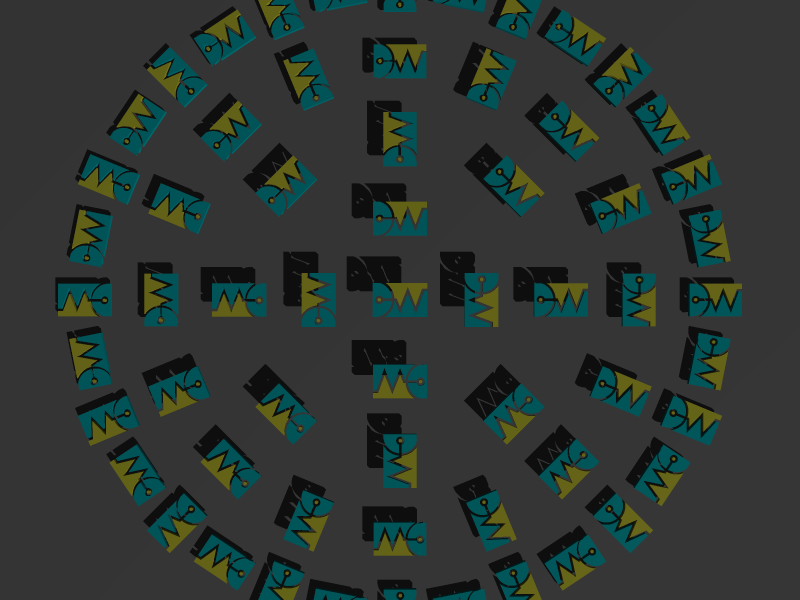 |
Render time: 12750.7 seconds (3 hours, 32 minutes, 30.6948 seconds) |
|
Revision 379
I finally got around to implementing Refraction. Equations for refracted rays derived from Snell's_law.
